Paso Robles is pursuing a Federal Aviation Administration Commercial Spaceport License at the Paso Robles Municipal Airport, and the city has been working toward this goal since 2022. As of June 2026, the project is actively moving into the licensing phase, with proposals due August 3 and work expected to begin as early as October. For property owners and buyers paying attention to long-term growth in North San Luis Obispo County, this is worth understanding.
What Is the Paso Robles Spaceport, and How Far Along Is It?
The city has been building toward this for four years.
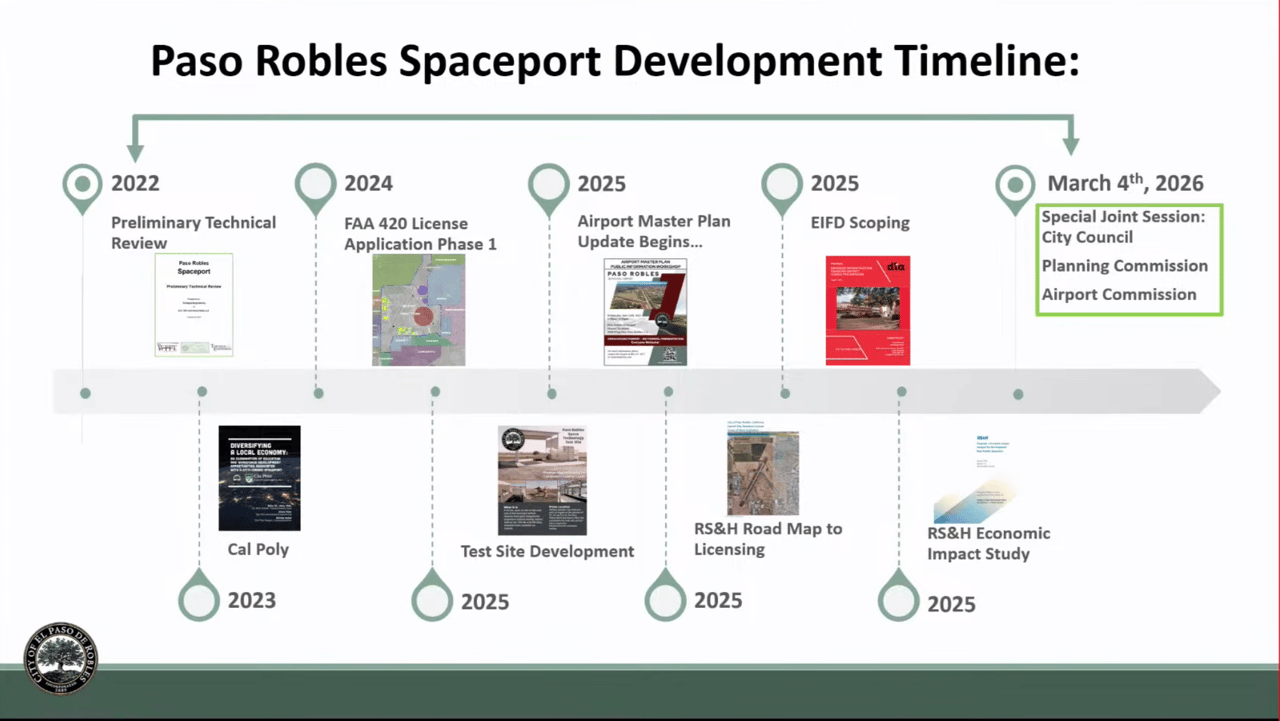
The development timeline tells the story clearly. In 2022, the city completed a Preliminary Technical Review. In 2023, Cal Poly produced a workforce development study examining how a spaceport would diversify the local economy. By 2024, the city filed an FAA 420 License Application Phase 1. In 2025 alone, the Airport Master Plan update launched, a Test Site was developed, engineering firm RS&H delivered both a Road Map to Licensing and an Economic Impact Study, and the city completed scoping for an Enhanced Infrastructure Financing District (EIFD). The March 4, 2026 joint session of the City Council, Planning Commission, and Airport Commission was the culmination of all that groundwork.
Now the city is seeking a consultant team with expertise in FAA launch site licensing, spaceport planning, environmental compliance, airspace coordination, and launch safety analysis. The FAA license process requires extensive technical, operational, safety, and environmental review. That work starts this fall if the timeline holds.
Why Paso Robles?
The city's site makes a strong case. The Paso Robles Municipal Airport sits on approximately 1,300 acres, which allows for space launch operations without displacing existing aviation activity. The location benefits from proximity to Silicon Valley's technology sector and Vandenberg Space Force Base, which is already one of the most active launch sites in the country.
The city is also connecting the project to local education institutions. K-12 schools, Cuesta College, and Cal Poly San Luis Obispo are already being incorporated into workforce pipeline development for careers in aerospace, advanced manufacturing, and skilled technical trades.
Paso Robles Mayor John Hamon said the project positions the city as a leader in California's aerospace economy, with the potential to bring higher-paying tech jobs and attract investment around the airport corridor.
What Kind of Businesses Would a Spaceport Bring?
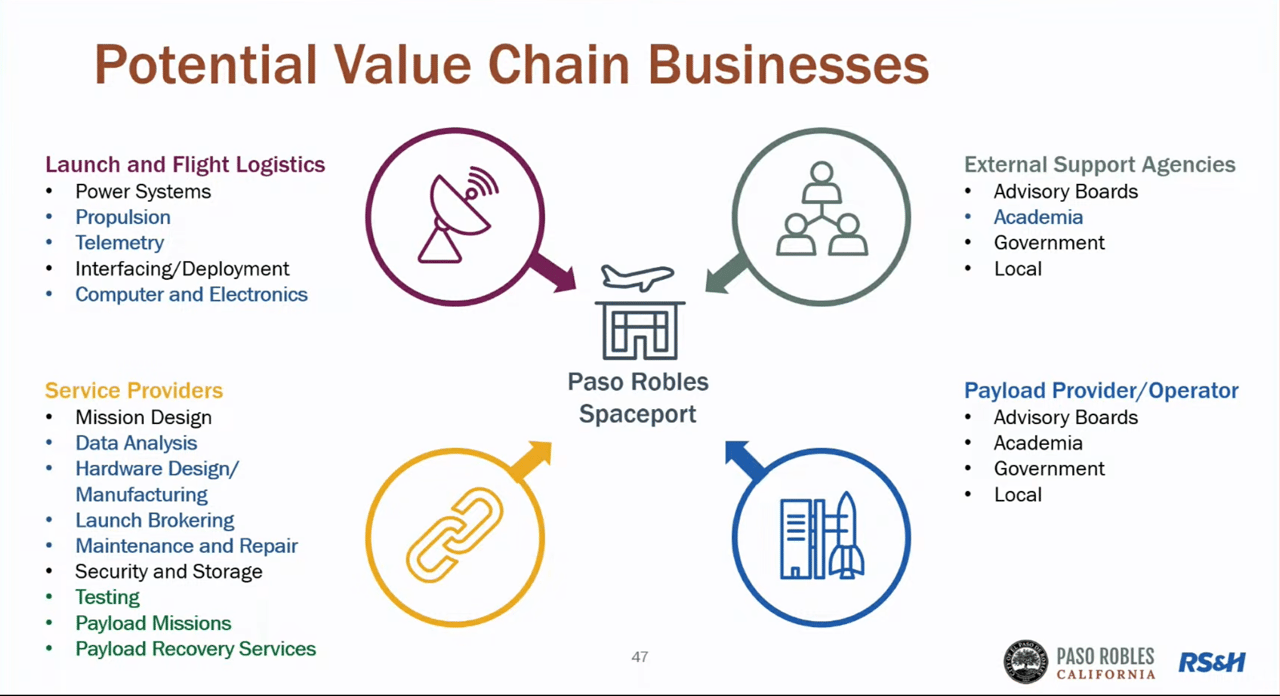
The city's planning materials lay out an entire ecosystem. The Paso Robles Spaceport is designed to anchor a value chain of supporting businesses across four categories.
Launch and flight logistics companies would handle power systems, propulsion, telemetry, interfacing and deployment, and computer and electronics. Service providers would cover mission design, data analysis, hardware design and manufacturing, launch brokering, maintenance and repair, security and storage, testing, payload missions, and payload recovery services. Payload providers and operators would include advisory boards, academic institutions, government agencies, and local businesses. External support agencies round out the network.
This is not a single-use facility. The model is designed to generate a cluster of specialized businesses operating in and around the airport corridor.
What the Numbers Actually Say
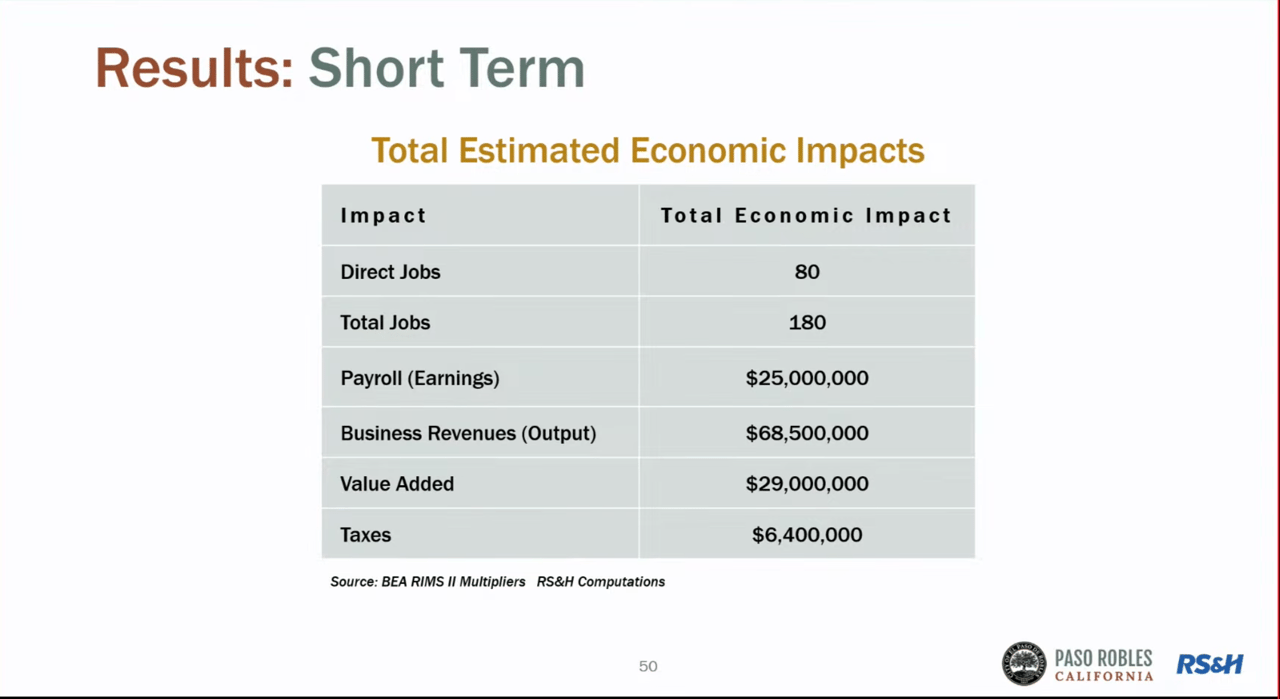
The RS&H Economic Impact Study, completed in 2025, puts projections on the table in two phases.
In the short term, the spaceport is projected to generate 80 direct jobs and 180 total jobs, with $25 million in payroll earnings, $68.5 million in business revenues, $29 million in value added to the local economy, and $6.4 million in taxes.
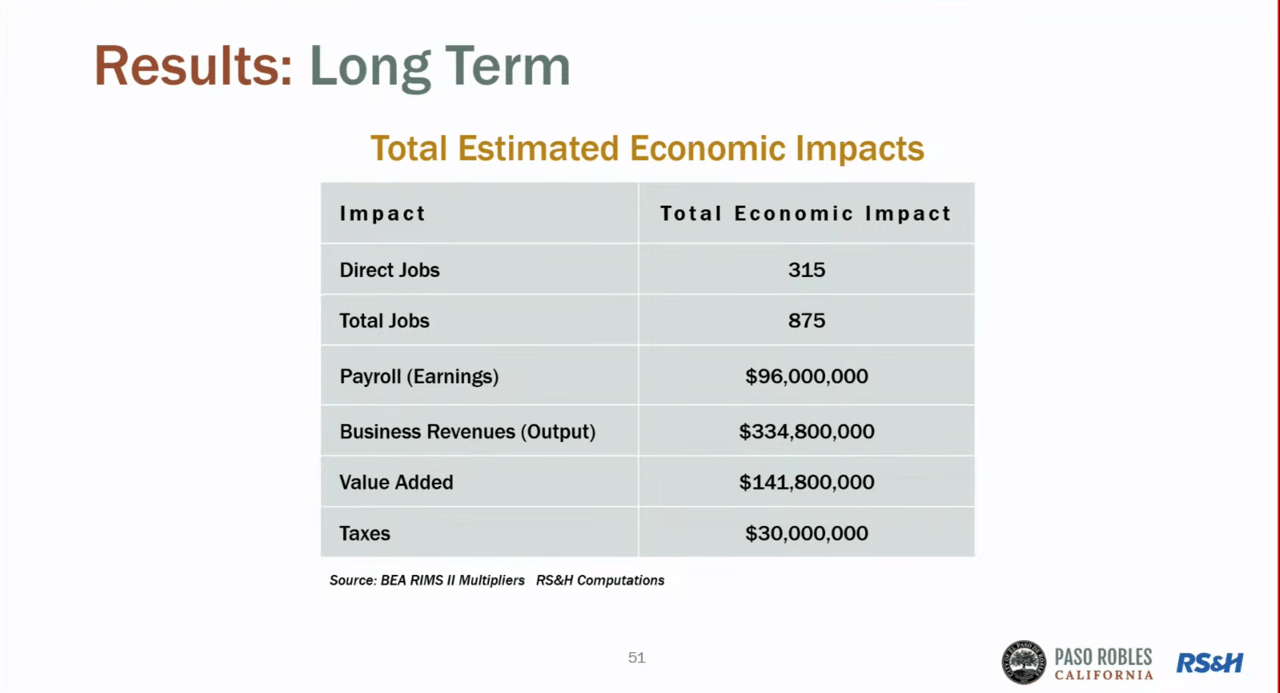
Long term, those numbers grow substantially: 315 direct jobs, 875 total jobs, $96 million in payroll earnings, $334.8 million in business revenues, $141.8 million in value added, and $30 million in taxes. Source: BEA RIMS II Multipliers, RS&H Computations.
These are projections, not guarantees. They are contingent on the FAA licensing succeeding, private investment following, and the Tech Corridor developing as planned. But they represent the city's officially commissioned estimate of what this project is worth to the local economy, and they are significant for a market the size of Paso Robles.
What Does This Mean for North County Real Estate?
That is the right question to ask, and the honest answer is: the timeline matters.
A spaceport license application does not equal a spaceport. The FAA process is complex and multi-year. Development of the Tech Corridor near the airport will move on its own timeline, influenced by licensing outcomes, environmental review, and private investment decisions. Anyone expecting immediate price appreciation tied to this announcement is getting ahead of the facts.
That said, the trajectory here is real and the numbers are not speculative in origin.
Workforce housing is the clearest near-term implication. Even the short-term projection of 180 total jobs represents meaningful demand in a constrained housing market. Long-term, 875 total jobs with $96 million in annual payroll is a genuine driver. These are aerospace, engineering, and technical trade positions. That income profile has real purchasing power in the North County residential market.
Commercial and industrial land near the Paso Robles airport is the most directly affected category. A tech and aerospace employment corridor changes the demand picture for that corridor over time.
For rural residential and ranch land sellers in the broader Paso Robles area, a growing high-income employment base expands the buyer pool for rural properties, equestrian estates, and wine country acreage over time. That effect is slower to materialize but structural in nature.
None of this happens on a short timeline. But for property owners thinking about when and what to sell, and for buyers evaluating long-term value in North County, this is the kind of economic shift that shapes markets over a decade.
The Bottom Line
Paso Robles has been quietly working toward a spaceport for four years. The project is now in a formal licensing phase with real deadlines and a city that has invested significant resources in planning infrastructure, economic studies, and institutional partnerships. The business ecosystem being developed around the spaceport is broad-based and includes aerospace, manufacturing, logistics, and support services. The education pipeline connecting K-12, Cuesta, and Cal Poly to these careers is already in development.
For North SLO County, this is a long-range story. But the groundwork is more advanced than most people realize.
If you own property in the Paso Robles area and want to understand how infrastructure and economic development trends factor into your timing decisions, we are glad to have that conversation.
Lane & Jane Karney | REALTORS 925-286-8981 | [email protected] DRE 02165892 & 02165893
Frequently Asked Questions
When will the Paso Robles spaceport be built? The city is currently in the FAA licensing application phase. Proposals from consultants are due August 3, 2026, with an anticipated award by September and work starting in October. The full FAA licensing process involves technical, environmental, and safety review and will take additional time beyond that.
What kind of jobs would a spaceport bring to Paso Robles? The planning materials identify roles in aerospace engineering, propulsion, telemetry, mission design, hardware manufacturing, payload operations, and skilled technical trades. The city is building education pipelines through K-12 programs, Cuesta College, and Cal Poly SLO to prepare local workers for these careers.
Will the spaceport affect home prices in Paso Robles? Not immediately. Long-term, a significant employment corridor near the airport could increase housing demand across North County, which would affect residential values. The timeline depends on how quickly the FAA process advances and how private investment follows.
What is the Tech Corridor near the Paso Robles airport? The Tech Corridor is a planned development zone near the Paso Robles Municipal Airport intended to house aerospace and technology businesses tied to the spaceport. It is part of the broader Spaceport and Technology Corridor project the city has been developing since 2022.
Does the spaceport project affect rural or ranch properties in the Paso Robles area? Indirectly, over time. A growing high-income employment base in the region expands the buyer pool for rural residential, equestrian, and agricultural properties. For sellers evaluating long-term timing, this type of structural economic shift is a relevant factor in the broader market picture.